The open platform for
Dynamic 4D geometry data

Open4D is an open, research-driven platform for the representation, compression, processing, evaluation, and streaming of time-varying 4D geometry — built for XR, robotics, teleoperation, digital twins, and autonomous systems.

terminal
# Install Open4D (development)
$ git clone https://github.com/open4dfoundation/Open4D.git
$ cd Open4D
$ pip install -e .
# Play a time-varying mesh sequence
$ python examples/play_mesh_o4d.py
6+
Research modules
3
Languages — Python, C#, C++
5
Ecosystem layers
XR
Runs on Meta Quest 3
News

Latest updates

Jul 2026

Open4D website launched

A new home for docs, modules, benchmarks, and the project roadmap.

Jun 2026

N4MC and TSMC integrated as core compression modules

Neural time-varying mesh compression and 4D scene mesh compression now ship as submodules.

May 2026

Unity decoder plugin runs on Meta Quest 3

Real-time 4D mesh decoding on standalone XR headsets via the Unity plugin.

Apr 2026

Open4D core API released on GitHub

Canonical 4D data models, IO readers/writers, and quality metrics — installable with pip.

Why Open4D?

Let research compound,
not reset with every paper

Today, 4D geometry pipelines are fragmented — algorithms live in paper-specific codebases, evaluation scripts are ad hoc, datasets and metrics are inconsistent, and systems integration is repeatedly re-implemented. Open4D provides a common substrate:

  • Stable 4D data abstractions — time is a first-class signal, not an afterthought
  • Reusable IO and metrics — shared readers, writers, and quality measures
  • Modular research algorithms — modules evolve independently on a stable core
  • Reproducible benchmarks — explicit, scriptable, paper-reproducible
  • Systems-aware evaluation — bitrate, latency, and temporal stability included
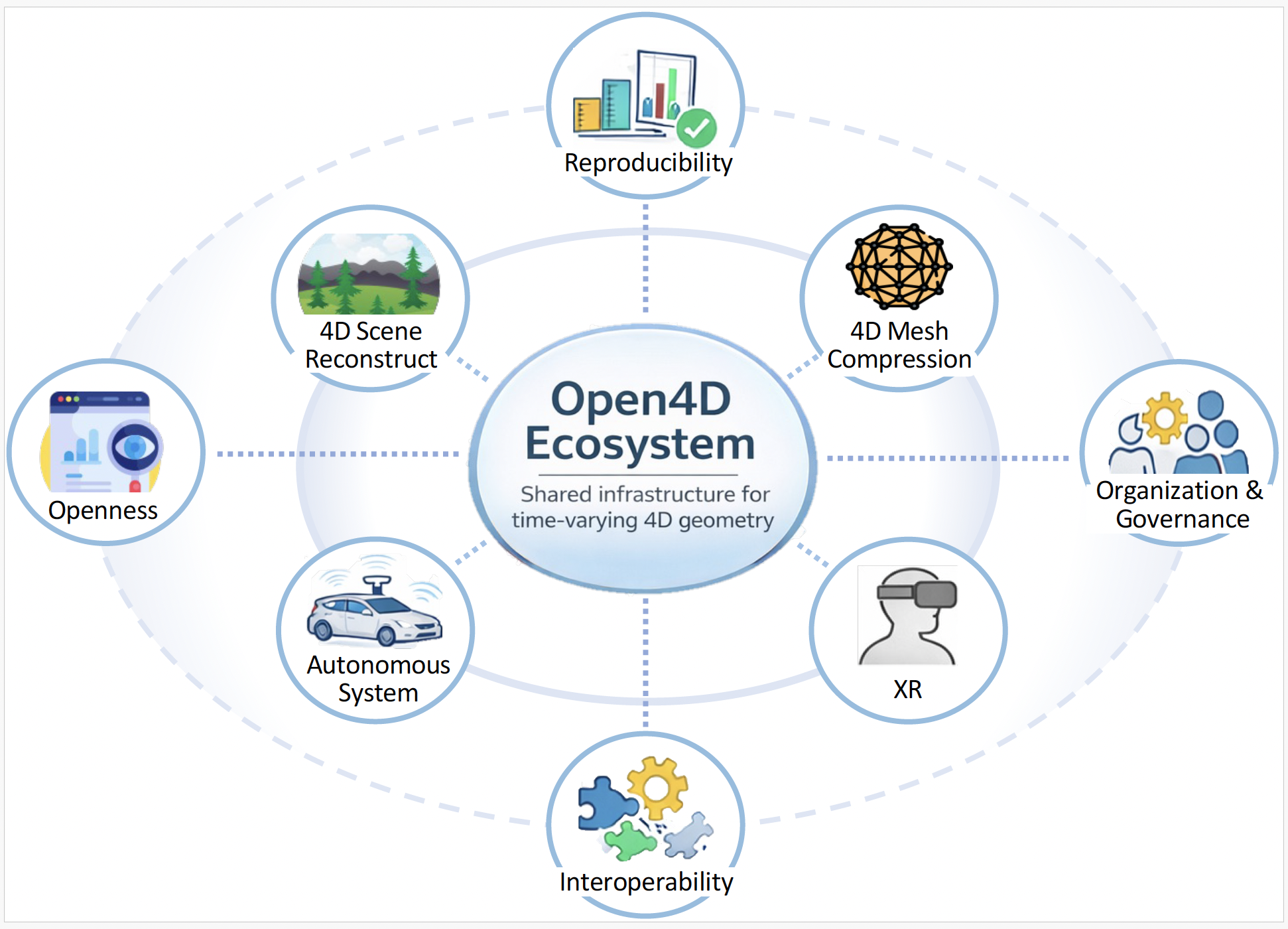
Open4D ecosystem layers diagram
The Open4D ecosystem. Core API, research modules, benchmarks, apps, and bindings — separated by design so each layer can evolve independently.
Core Features

Everything 4D, in one stack

From canonical data structures to on-headset playback, Open4D covers the full lifecycle of time-varying geometry.

4D Data Structures

Canonical representations for time-varying meshes and point clouds — the .o4d data model treats time as a first-class dimension.

IO Readers & Writers

Unified readers and writers for mesh sequences, point-cloud streams, and Draco-compressed point clouds — one API across formats.

Compression Codecs

State-of-the-art encoders and decoders for 4D meshes — neural (N4MC), scene-level (TSMC), and time-varying mesh compression (TVMC).

XR Playback

A Unity decoder plugin decodes and renders 4D meshes in real time on XR headsets, including the standalone Meta Quest 3.

Quality & Temporal Metrics

Systems-aware evaluation out of the box: geometric distortion, bitrate, latency, and temporal-stability metrics for streaming pipelines.

Reproducible Benchmarks

Paper-reproducible experiment code with reimplemented baselines, configs, and scripts — so results are comparable across papers.

Research Modules

Built by researchers, for researchers

Independent modules on top of the stable core API. Each ships with code, configs, and evaluation scripts.

Compression

N4MC

Neural time-varying mesh compression — learned codecs for dynamic mesh sequences.

Learn more →
Compression

TSMC

Time-varying 4D scene mesh compression for full dynamic scenes.

Learn more →
Compression

TVMC

Time-varying mesh compression exploiting temporal redundancy across frames.

Learn more →
XR / Unity

Unity Decoder Plugin

Real-time 4D mesh decoding in Unity — runs on XR headsets like Meta Quest 3.

Learn more →
Tracking

ARAP Volume Tracking

Deformation-aware temporal alignment using as-rigid-as-possible volume tracking.

Learn more →
Editing

Temporal Mesh Editing

Structured editing of dynamic geometry that stays consistent across time.

Learn more →
Quickstart

From clone to playback
in three commands

Open4D installs as a standard Python package. Bundled examples let you load, convert, and play time-varying meshes and point clouds immediately — including Draco-compressed point-cloud streams.

Read the docs
install & run
# clone and install
git clone https://github.com/open4dfoundation/Open4D.git
cd Open4D
pip install -e .

# play a 4D mesh sequence
python examples/play_mesh_o4d.py

# play a Draco-compressed point cloud
python examples/play_draco_pointcloud_o4d.py
Citation

Using Open4D in your research?

If Open4D is useful in your work, please cite the project.

BibTeX
@software{open4d2026,
  title  = {Open4D: An Open Platform for Time-Varying 4D Geometry Data},
  author = {Spatial Intelligence Research Group},
  year   = {2026},
  url    = {https://github.com/open4dfoundation/Open4D}
}

Build the future of 4D with us

New modules, benchmarks, datasets, metrics, and documentation are all welcome. Open4D is an open research platform — contributions compound.

Contribute on GitHub About the project